How to sell to state agencies: a practical guide for B2G sales teams
Learn how state agencies are funded, how buying decisions form before a solicitation, which routes exist beyond open bids, and how to time outreach.

Most sellers encounter a state agency for the first time on a bid board, months after the agency has decided what it wants and what it will pay. The purchasing decision that matters happens earlier, inside a program office and a budget request.
This guide explains how state agencies are funded, how a purchase is defined before a solicitation is issued, which routes allow an agency to buy without an open bid, and how to time outreach to the budget year.
How do you sell to state agencies?
Selling to a state agency means identifying the agencies that have buying intent in your category, reaching the program staff who define the requirements months before the RFP, and matching your procurement path to a purchasing route the agency can already use.
State agencies: structure, funding sources, and buying authority
A state agency carries out a defined set of government functions, but the money it spends can come from several different sources.
The National Association of State Budget Officers estimates that total state spending in fiscal 2025 exceeded $3.2 trillion, funded through:
- General funds, 37.9 percent
- Federal funds, 33.5 percent
- Other dedicated state funds, 27.2 percent
- Bonds, 1.4 percent
For a seller, the practical consequence is that a single agency can pay for the same product from an annual appropriation, a dedicated fee account, or a federal grant the agency administers.
Each of those funding sources has its own timing and approval steps.
The office that needs the product and the office that buys it may also be different.
- The program office decides what problem it needs solved.
- A central procurement office, or an agency purchasing unit operating under delegated authority, decides how the purchase is made.
Before starting outreach, identify two things: who owns the problem and who controls the purchasing process.
A technology seller usually needs a named contact in both offices.
What happens inside a state agency before an RFP is published
Many state purchases begin long before procurement publishes an RFP.
- Program staff identify a problem or priority.
- The agency may then document that need in a strategic plan, technology plan, or budget request and compete for funding against other agency priorities.
Only after the project receives funding does the agency typically move toward defining requirements and choosing a procurement path.
The agency documents each of these steps in public records.
An agency’s strategic and technology plans describe the problem in the agency’s own words. Budget requests assign a dollar figure to that problem.
Public board, commission, and legislative committee meetings show whether the request is advancing or stalling.
Statewide priority reports provide another signal by showing which needs are appearing across many agencies at once. For example, state chief information officers named artificial intelligence, cybersecurity, and budget and cost control as their top three priorities for 2026 in a survey of 51 state and territory technology leaders reported by StateTech Magazine.
For a sales rep, these records create an opportunity to engage before requirements are finalized.
A rep who reaches out about a problem the agency has already identified can start a conversation around an active priority rather than waiting for the solicitation.
How a leadership change opens a state agency account
A new agency director, state chief information officer, or program administrator often resets vendor relationships and publishes revised priorities within the first year in the role.
The new leader’s team often reviews incumbent contracts, and stalled projects either restart or end.
Treat a confirmed leadership change as a reason to introduce yourself within the first 30 days after the change.
Tracking those plans, budget documents, and meeting records by hand does not scale.
A single state runs dozens of agencies, and each agency publishes those documents on its own schedule.
If you want to automate the manual lead research process, consider Starbridge.
Starbridge is the AI GTM platform for companies selling to the government, K-12, and higher education, helping teams prioritize the right accounts, engage the right people earlier, and identify high-intent opportunities before the competition.

The Buying Signals Monitor watches 320,000+ government and education entities and surfaces the buying indicators that precede a solicitation, from new budget lines to leadership changes.
Zencity sources 50% of its cold meetings from Starbridge, and its reps pull account priorities in seconds instead of the 20 to 30 minutes they once spent per prospect.
Timing outreach to the state budget and fiscal calendar
A state agency’s purchasing year follows the appropriation calendar, so the month a rep reaches out changes what the agency can do with the request.
Every state begins its fiscal year on July 1, except four states. New York starts on April 1, Texas on September 1, and Alabama and Michigan on October 1, according to the National Association of State Budget Officers.
The productive outreach window opens while agencies prepare their budget requests, usually in late summer and fall before the legislative session.
Once the legislative session begins, the agency is defending a budget number it has already committed to, so a seller arriving then is arguing against a budget that may be fixed.
Budgets are usually enacted only weeks before the fiscal year they fund begins. As of July 1, 2026, 45 states had enacted a full-year budget for fiscal 2027, and Kentucky, Virginia, and Wyoming had enacted two-year budgets covering fiscal 2027 and 2028.
Tight state budgets can also narrow which projects get funded at all. NASBO’s spring 2026 survey projected median general fund spending growth of 0.6 percent for fiscal 2027, compared with revenue growth of 2.5 percent.
An agency with almost no new money will fund the project already included in its request, not one a vendor proposes in March.
This means sales teams should build the outreach calendar around each target state’s budget request season and session dates, and start a year earlier in states that budget on a two-year cycle.
Entry routes into a state agency beyond the RFP
A state agency must run an RFP only when a purchase exceeds the dollar threshold set by its state, and each state sets its own threshold.
Agencies set different dollar thresholds for purchases that can be done without an RFP, so a $40,000 deal is a purchase order in one state and a full competitive solicitation in another.
If the contract value is above the so-called ‘sole source thresholds’, there are other ways to bypass the RFP.
For example, cooperative contracts remove the need for the agency to run its own solicitation, and 40 of the 43 states responding to NASPO’s survey had authority to purchase cooperatively with other state governments.
The contracts on the cooperative purchasing program NASPO ValuePoint reach state agencies through a lead state. That lead state runs the competitive solicitation, and a state central procurement office then executes a statewide participating addendum that makes the contract available to buyers in that state.
Each state decides which of its entities may use each contract, including state agencies, public universities, and local governments.
Sales reps should ask the program contact and the procurement contact which route this specific purchase will take.
Their answer tells you whether you are selling into a purchase order that can close this quarter or into a competitive process that runs most of a year, and it should change both your pricing and your forecast.
Vendors that do not hold a cooperative contract of their own can still sell through a reseller or partner that already holds one.
Selecting target state agencies and reaching decision-makers
Rank state agencies on buying-intent evidence you can verify in public records:
- Whether the agency has written a funded priority in your category
- Which purchasing route the agency can use for a purchase your size
- When the incumbent contract ends
One agency with a budgeted project and an available cooperative contract deserves more attention than ten agencies that only appear to be a fit.
Inside each ranked agency, work these roles in this order:
- The program owner, who names the problem and controls whether the project stays in the budget
- The technical evaluator, who judges whether your product fits the agency’s environment and often drafts the requirement language
- The procurement contact, who controls the purchasing route and the calendar
Reps who open with procurement are usually told to watch the bid board, because a procurement office cannot create a requirement the program office has not requested.
Getting to the right person is only the start. Follow-through closes more of these deals than the initial touch.
A funded state project can sit between a budget request and a solicitation for a year or longer, so a rep needs a new reason to return each quarter. Any of these events can provide one:
- A new budget document
- A meeting where the project came up
- A change in the incumbent contract
- A new person in a decision-making role
Running that ranking and follow-through for one agency is easy. Running it across your entire TAM, which may span hundreds of agencies, requires more than a rep working from a spreadsheet and calendar reminders.
That’s one of the reasons we’ve built Starbridge.
Starbridge scores every agency on funded priorities, purchasing routes, and contract timing, then pairs each account with verified decision-maker contacts, including extension-level phone numbers and government email addresses that generic B2B databases often get wrong.
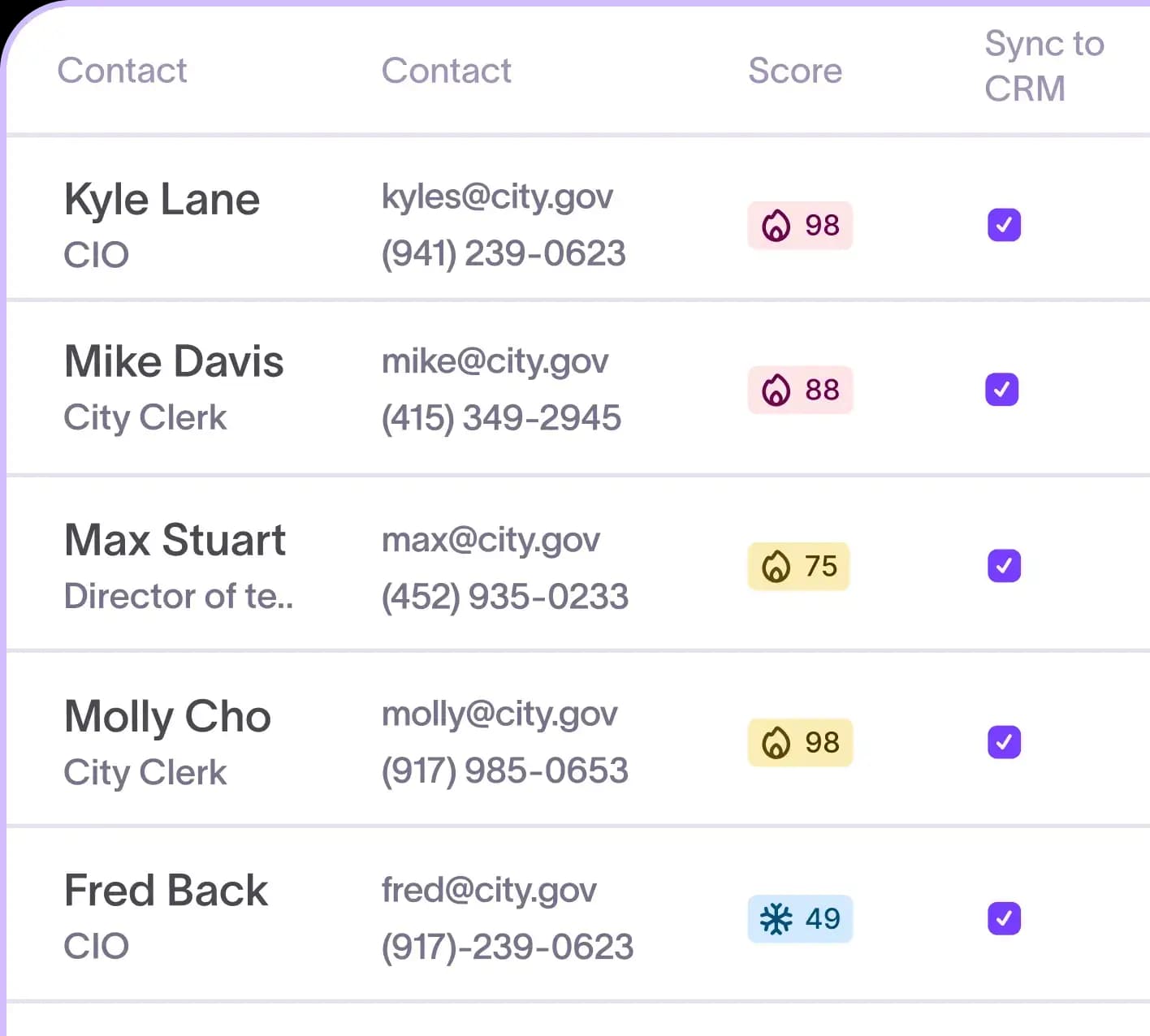
The state and local team at Abnormal AI saves 10 hours per rep per week on research.
As Zach Oxman, Area VP for U.S. State, Local Government and Education, put it, “Instead of going to 10 or 15 different places to find information, it lets us get actionable really quickly in one central place.”
Your reps have a fixed number of hours each week.
The choice is whether those hours go into finding the agencies with funded projects or into working those agencies.
Working state agencies upstream of the bid board
Selling to state agencies rewards teams that work upstream of the RFP.
The agency defines its priority and competes for funding against every other request it submits. It then chooses a purchasing route and publishes a solicitation last.
A seller who appears only at that final step may be bidding against a requirement someone else helped shape.
Build the motion in the order the agency actually follows, and reach out early.
- Learn where each target agency’s money comes from and which office oversees the purchase.
- Read the plans, budget requests, and meeting records that show a project taking shape.
- Time outreach to the state’s budget season rather than to your own quarter.
- Ask which purchasing route the agency can use before you set a price.
Want to see which state agencies in your territory have funded projects right now? Book a demo.
Frequently asked questions
The fastest wins sit below a state’s competitive threshold or on a cooperative contract the agency can already use. A $40,000 purchase may need only a purchase order in one state and a full solicitation in another, so check the sole source threshold first.
Vendor registration usually happens through the state’s central procurement system, where you create a profile, select relevant commodity codes, and may subscribe to solicitation alerts.
Requirements vary by state. Some require registration before bidding or contracting; others do not. Either way, registration can make you eligible to compete or easier for buyers to find, but it does not create buyer demand.
A purchase that requires a new budget request typically takes a year or longer, because the request must pass through an entire budget cycle before anyone drafts requirements. Purchases using an existing cooperative contract or falling under a small-purchase threshold can close in weeks.
Once a solicitation opens, communication normally goes through the designated procurement contact, and side conversations with program staff can disqualify a bidder. The productive contact happens earlier, while the agency is still deciding what to request.
The money and the calendar differ. A state agency depends on legislative appropriations and a statewide procurement office, while a city council or school board approves purchases locally. State cycles run longer and cover more spending.
Explore our use case library
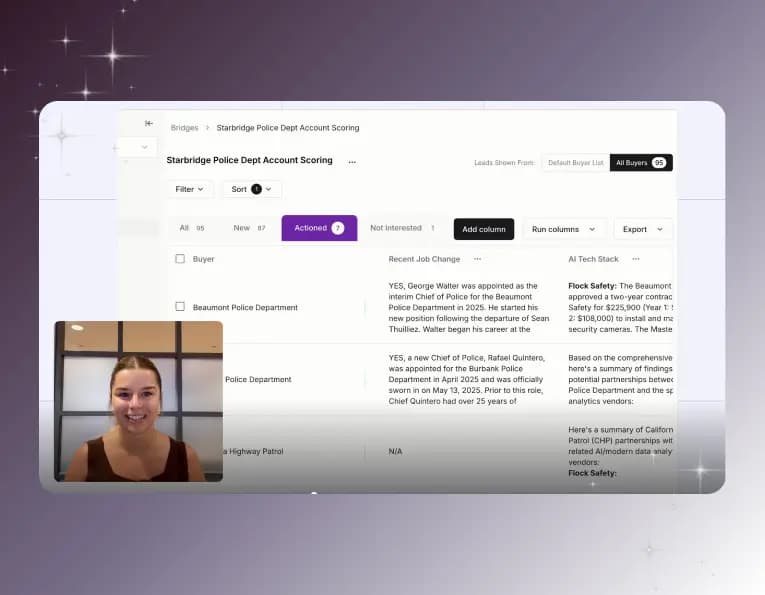 Automate account research with AI agentsStop manually researching accounts. Starbridge AI agents automate account research by monitoring buying signals 24/7 and surfacing the right contacts.
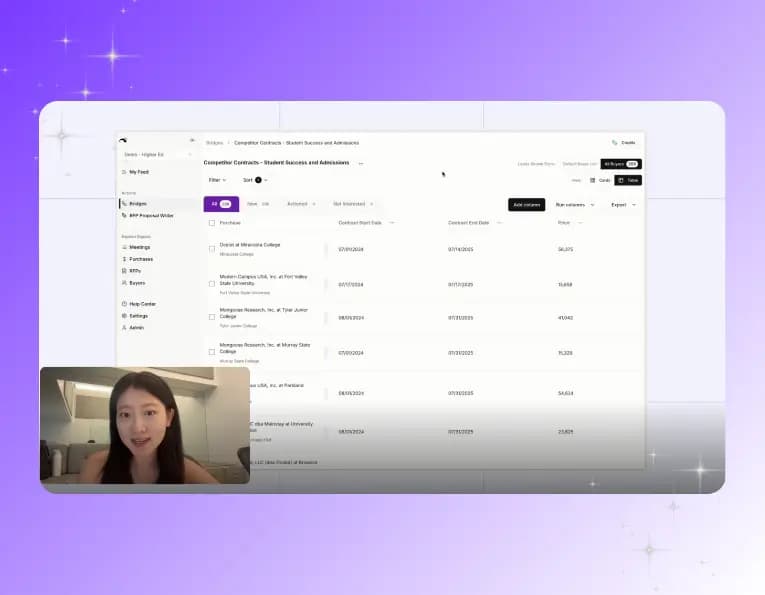 Identify competitor contract expiration datesThe RFP is usually a formality. Starbridge surfaces competitor contract expiration dates so your reps reach accounts before the renewal cycle closes.
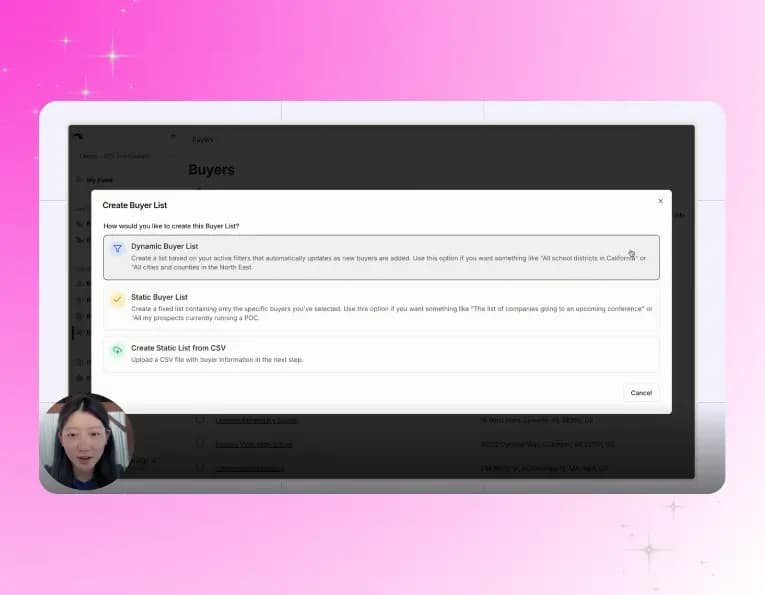 Create a conference campaignTurn conference badge scans into pipeline. Import your contact list, surface buying signals across every account you met, and follow up with context.